FLASH SALE -25% for registered users only - Log in or Register

Scandinavian style at the table: how to recognise it and bring it home

Clean shapes, a neutral palette and contrasting materials define Scandinavian style at the table — this guide shows how to recognise it and bring it home. Sambonet's Siro cutlery, developed by the Sambonet Design Centre, is a concrete expression of it.

Nordic tradition at the table, essential for Scandinavian place settings

Scandinavian design emerged in the mid-twentieth century and has shaped much of contemporary interior culture ever since: essential forms, function before ornament, materials shown for what they are. Applied to the table, this language becomes objects that strip away the superfluous without giving up everyday practicality.

What Scandinavian style means

What does Scandinavian design at the table actually mean?

Scandinavian design is a design language born in the Nordic countries in the 1950s, built on three principles: functionality, formal essentiality and honesty of materials. At the table, this means avoiding decoration for its own sake and letting the object's form — its proportion, its profile — carry the design. It isn't a matter of colour or season, but of structure: clean lines, few surfaces, sharp contrasts between different materials.

Why Scandinavian design strips away decoration

Scandinavian design treats ornament as something to justify, not to add by default. A shape earns its curve, a handle earns its taper — if a detail doesn't serve function or structure, it's left out. This isn't emptiness for its own sake: the restraint is what makes proportion, material and finish visible on their own terms, without competing decoration around them. The result is an object that reads clearly at a glance, because there's nothing extra between the eye and the form.

How to recognise Scandinavian style in a piece of cutlery

A few concrete criteria help tell a Scandinavian-inspired piece of cutlery from something that merely looks minimal:

  • Contrasting handle — often in a different material from the blade or tines, with a sharp transition rather than a gradual one
  • Rounded edges — soften the profile without adding decoration
  • Neutral palette — black, ivory, grey: colours that don't compete with the plate or the table
  • Constructive coherence — the join between different materials is designed to go unnoticed, integrated into the design rather than hidden.

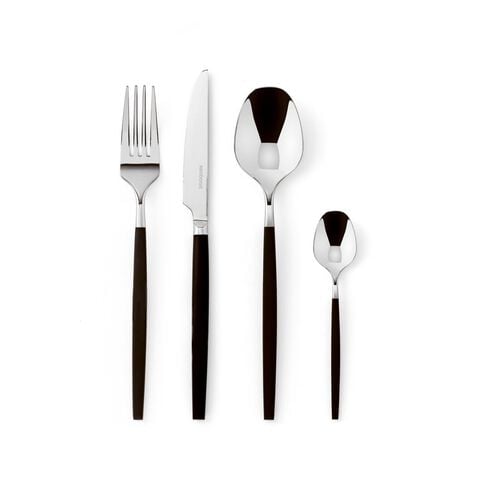
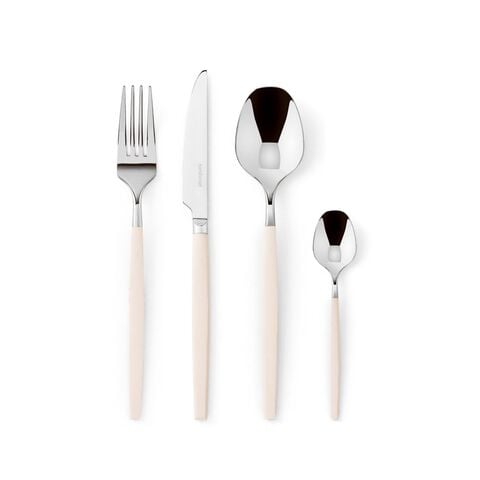
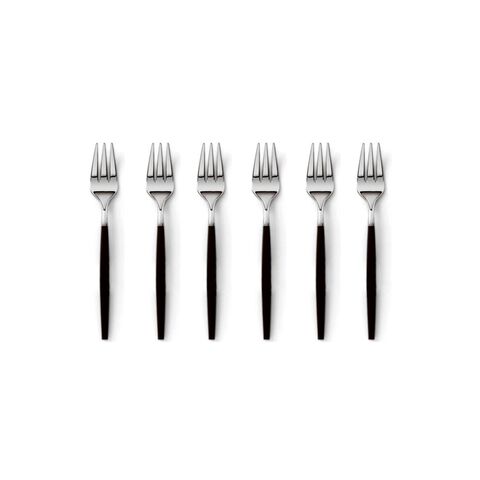
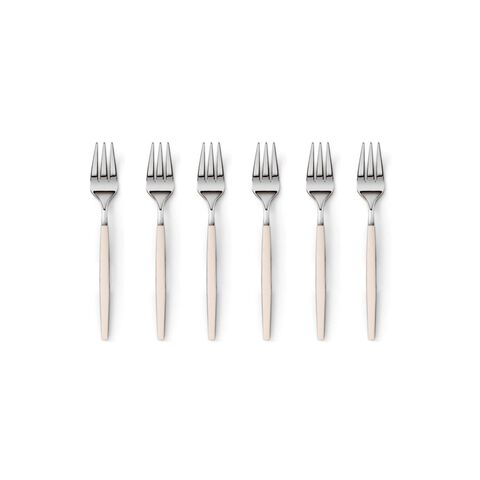
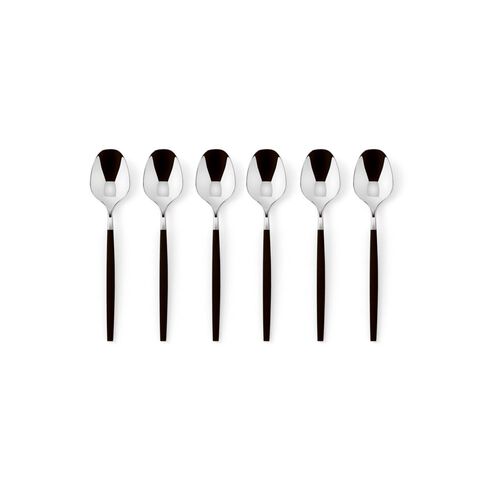
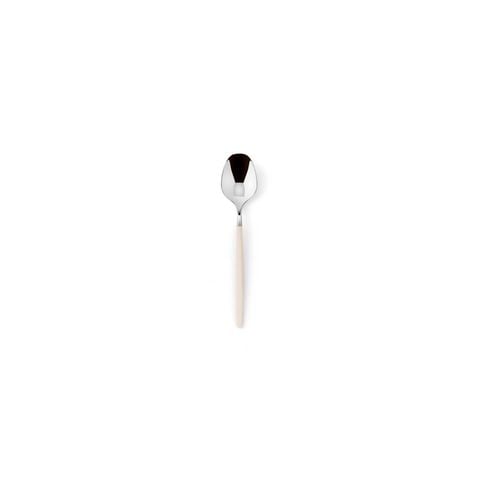
Siro's two finishes, black and ivory, are designed to work in exactly this register: they sit against a white or light grey tablecloth without introducing a third colour to the composition.

PALETTE

Colours and materials

The Scandinavian table palette is built by subtraction: white, grey, black, the natural tones of pale wood and raw linen. Colours don't compete with one another — each surface (tablecloth, plate, cutlery) stays legible on its own rather than merging into a single decorative effect. The preferred contrast is tonal, not chromatic: black on white, ivory on light grey, never more than two or three tones in the same setting.

ACCESSORIES

Flowers, linen and candles

The Scandinavian table favours untreated natural elements: wildflowers or dried stems (eucalyptus, wheat ears, twigs) in minimal vases or single stems, raw linen tablecloths and runners, low, diffused candles rather than one scenographic centrepiece. The rule is the same as for the cutlery: a recognisable form, no superfluous ornament.

FOOD

What's served

Traditional Nordic cuisine favours simple, shared dishes: open sandwiches (smørrebrød), cured salmon, cheeses and rye bread, baked goods like cinnamon rolls for the coffee moment. It's a cuisine suited to informal service, often buffet-style or shared at the centre of the table. The same principle extends beyond Nordic food itself — a plate of spaghetti included — because the rule is about the table setting, not the cuisine on it.

Siro: Scandinavian-inspired cutlery

Siro (Finnish for "slim") comes from the work of the Sambonet Design Centre, joining stainless steel and PBT — a durable plastic polymer — into a single body.

Explore Siro  

FAQ — Frequently Asked Questions About Scandinavian Table Style

Everything you need to know about the style, its colours, and how it fits everyday use.

A design language born in the Nordic countries in the mid-twentieth century, based on functionality, formal essentiality and honest use of materials, still influential across the interior sector today.

A few variables are enough: cutlery with a clean profile, a neutral palette (black, ivory, grey), and the removal of purely decorative elements, while keeping the setting functional.

A restrained, tonal palette: white, grey, black and the natural tones of pale wood and raw linen. Colours are chosen to avoid competing with one another — the goal is a setting where each surface stays legible on its own rather than blending into a single decorative effect.

Simple, shareable dishes are typical: open sandwiches, cured fish, rye bread and cheeses, with baked goods reserved for the coffee moment. This style of food suits informal, buffet-like service rather than an elaborate multi-course setting.

Yes — its restraint makes it easy to mix with other language, from Japanese minimalism to contemporary Italian design, as long as the core principles (clean forms, limited palette, no superfluous ornament) are kept consistent across the elements on the table.

OOPS! The browser you are using is no longer supported.

Browse Sambonet.com using the latest version of Microsoft Edge, Chrome, Mozilla Firefox or Safari and prepare to dive into an extraordinary beauty experience.